For your information
You are being redirected to one of our divisional subsites which contains more detailed information on the required division. To navigate back to the main Invicta Group site, please click the link found in the footer at the bottom of the page.


- Systems
- Applications
- Services
- Projects
- Insights
- Contact
Contact

UK +44 1843 220 256

US +1 305 328 9444

UAE +971 4 277 6225

Qatar +974 4441 4340

India +91 79945 14049

Malaysia +60 16 286 6225
- Start your project

What is mobile shelving? Everything you need to know
9th October 2023
Quick Quote
Contact David Learoyd
To get a quotation or arrange a free site survey - Call David Learoyd on
-
 UK
UK
Current location:
Quick Quote
Contact David Learoyd
-
UK
Current location:
It’s hard to get people enthused about shelves, particularly in the workplace. Yet replacing your business’ shelving can be a surprisingly transformative decision. The right shelving can save space and increase the amount you can store, allowing you to repurpose space for other applications, or even delay a move elsewhere.
The best way for most businesses to increase their storage space is mobile shelving. Yet despite the many benefits that mobile shelving systems offer over static shelving, many people are still unaware of exactly what mobile shelving is, or the advantages it has. Here then is everything you need to know: what mobile shelving is, how it works, and why it’s such a useful storage option across a range of industries.
What is mobile shelving?
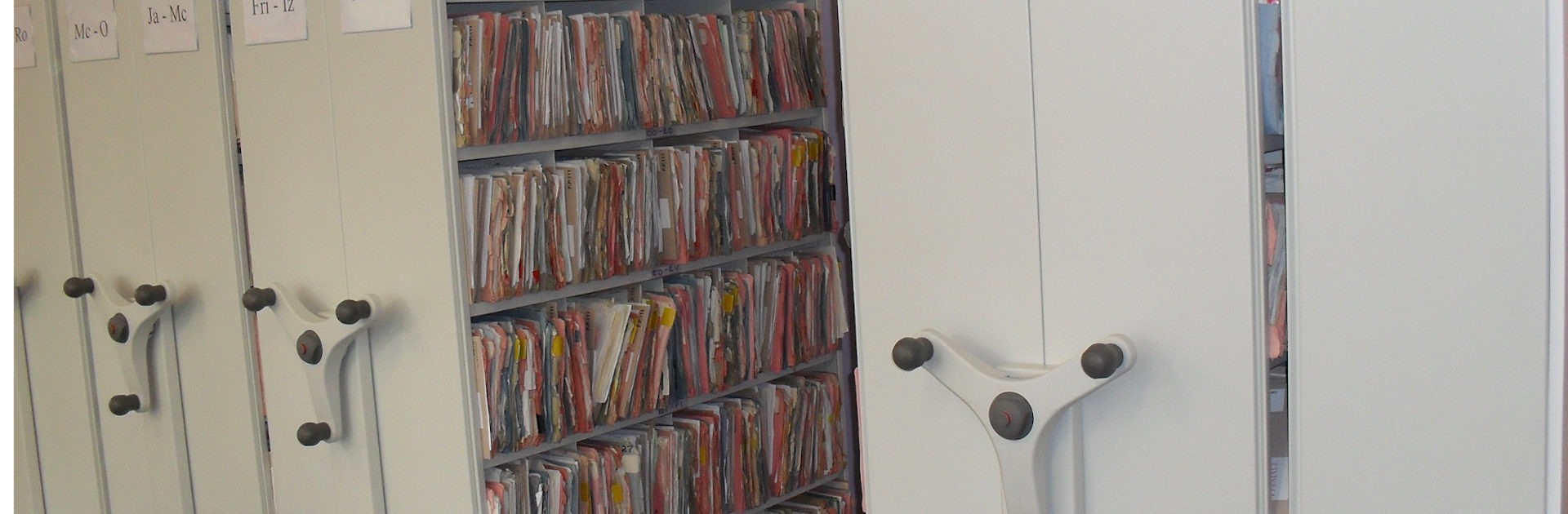
Mobile shelving is an efficient, high density storage solution designed to maximise the use of available floor space. Instead of shelves being fixed in place, mobile shelving units feature low-friction wheels, which allow the shelves to move along floor-mounted rails or tracks.
The shelving units on the end are single-sided, while the shelves in the middle can be double-sided. This means that the shelves can be compressed together when not in use, with the user creating a single aisle at a time to access whichever shelves they need.
The ability to compress shelving units together eliminates the need for multiple fixed access aisles, allowing more items to be stored in the same footprint compared to traditional shelving, or the same amount of items to be stored in a smaller footprint.
By compressing the shelving units together, mobile shelving can also be placed in publicly accessible areas without worrying about security. A variety of locking mechanisms can be used to lock the units together when not in use, allowing for both secure and climate controlled storage.
The space efficiency of mobile shelving makes it ideal for environments where space is at a premium, from public rooms or corridors to dedicated storage areas. The different configurations of mobile shelving and the ability to lock the unit allow it to be used in libraries, waiting rooms, and other public-facing areas with no risk of unwanted access.
How does mobile shelving work?
Mobile shelving operates on a system of carriages and rails. Each shelving unit is mounted on a carriage that moves laterally along rails or tracks embedded into or placed on the floor. Some mobile shelving (such as mobile picture racking) may also be ceiling-mounted to allow the racks to hang down, ideal for the storage and display of art or other items.
By turning a handle or pressing a button (in the case of powered systems), the shelves move smoothly along the rails, creating an access aisle wherever it’s needed. This allows for multiple shelving units to be positioned closely together, with the user creating an aisle where and when they require access.
Once the item or items have been retrieved, the shelves can then be closed and compacted together again. Mobile shelving systems can be provided with a locking mechanism to prevent them from being opened by unauthorised personnel, allowing storage units to be placed in public-facing areas with complete peace of mind.
What is the importance of mobile shelving?
Mobile shelving is primarily important because of the space it saves. By eliminating the need for multiple fixed aisles, mobile shelving can increase storage capacity by up to 50% within the same floor space. This can have a transformative effect on businesses who might otherwise need to relocate or pay for offsite storage to fulfil their storage needs.
The modular design of mobile shelving systems also allows for customisation based on specific needs, as well as allowing it to be easily expanded or relocated. This makes it highly adaptable to changing market conditions, and suitable for various industries and storage items. The systematic arrangement also means that retrieval and inventory management become more streamlined.
Mobile shelving also offers security that static shelving lacks, which can be a differential factor. Mobile shelving units can be designed to be lockable, ensuring that stored items are secure and protected from unauthorised access. This can provide an added layer of protection within a locked storage area, or protect shelves within a public-facing area.
What are the applications of mobile shelving?
While often stereotyped as being used only in libraries or medical facilities, mobile shelving is an extremely versatile and adaptable form of storage. Mobile shelving can be used anywhere where traditional shelving is employed, and adapted to many kinds of items.
Invicta has provided mobile shelving systems for museums, universities, retailers, offices, archives, legal firms, manufacturers, garages, and even orchestras. Anywhere where documents or smaller items are stored can benefit from efficient and accessible mobile shelving.
The simple benefits of mobile shelving — as much as doubling your storage capacity or halving your storage footprint — are applicable for most forms of storage. Mobile shelving can also be adapted to store many sizes and shapes of objects using different inserts and accessories.
Mobile shelving is also highly customisable to your business. We work closely with clients to design the perfect system for them, including colours and branding. Mobile shelving is also modular, and can be easily moved, repaired, expanded, or adapted to your changing needs.
What is the difference between static shelves and mobile shelves?
The primary distinctions are mobility and accessibility. Static shelves are fixed in place and don’t move, requiring a separate access aisle for each row. In contrast, mobile shelves can be moved to create a single adjustable access aisle, optimising space usage.
Mobile shelves typically use floor space more efficiently, as they reduce the number of access aisles required. Static shelves need multiple aisles, consuming more floor space for the same amount of storage. The enclosed nature of mobile shelving also means it is easier to keep clean and away from sunlight, ideal for the storage of sensitive items.
While both types of shelves can be customised, mobile shelves also tend to offer more modularity and adaptability. Mobile shelving is lockable, and can be branded to suit its surroundings, as well as modified to hold different types of containers. This allows businesses to adjust the system as their needs change.
The ability to use electronic operation to part the shelves also helps with accessibility. Push-button operation allows aisles to be opened up automatically, and the reduced size of the unit compared to static shelving means that traversal distances are lower for users.
What is roller racking?
Roller racking, often used interchangeably with mobile shelving, is a type of storage system where shelves are mounted on rolling carriages that move along tracks or rails. The rolling mechanism allows users to move heavy shelves with ease, providing quick access to the stored items.
Roller racking may be used to distinguish from mobile shelving where larger systems are involved, such as large library shelving or stock storage units. Roller racking systems are particularly useful in environments where space is limited, and there’s a need to maximise storage capacity.
Roller racking is widely used in libraries, offices, archives, and more due to their space-saving and efficient design. Roller racking can also be an alternative to fixed racking in warehouse environments, particularly for applications such as museum storage, where a large volume of items need to be stored while also being accessible and protected from the elements or intrusion.
What are Lloyd George patient records?
Lloyd George patient records are notes kept on patients by GPs. Named after former Prime Minister David Lloyd George, these standardised envelopes and records include the medical and treatment history of a patient, along with other pertinent information.
An estimated 3 billion Lloyd George patient records were thought to be held by UK GPs as of 2020. Despite a move to digitise these records, there is still an enormous demand for physical storage, both for surgeries that have not digitised and to keep physical copies as a backup. This is particularly important given ongoing data security issues with digital systems, which could lead to the sudden loss of important medical data.
Mobile shelving is relevant to Lloyd George patient records as they are an extremely common storage item. Our mobile shelving can be easily configured to store Lloyd George notes, and we have undertaken numerous projects for NHS surgeries and other facilities across the UK, where space and cost requirements make mobile shelving an ideal choice.
What are the advantages of storing information physically as opposed to digital copies?
Storing physical documents in mobile shelving creates certainty when it comes to data protection. As opposed to digital records, which can easily be lost, copied, or stolen, physical records can be easier to secure and protect.
Physical records may also be easier to locate and access for GDPR requirements, where personal data needs to be made available to customers, clients or users when requested. Mobile shelving can allow the storage of records that would otherwise not fit on-site, and would have to be stored at an external facility.
Some records also simply need to be stored physically, due to their value, historical significance, or legal requirements. In these cases, mobile shelving provides a secure, clean, efficient, and highly adaptable storage environment for valuable and unique items.
–
If you have any further questions about mobile shelving, we’d be happy to help. Explore our blog posts here to learn more, or check out our Systems pages using the menus above.
Alternatively, contact us today to discuss your unique storage requirements, and arrange a complementary site survey.
Accreditations & Affiliations








Share/Like this page